Stainless Steel Plates: Types, Uses, and Standards
Stainless Steel Plates: Types, Uses, and Standards
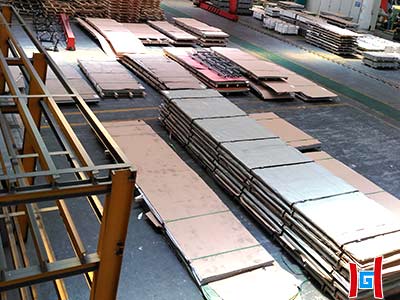
Stainless steel plates are essential in various industries due to their corrosion resistance and versatility. They are classified by manufacturing method, thickness, organizational characteristics, and use. This guide provides an overview of their types, applications, and technical standards.
Types of Stainless Steel Plates
Classification by Manufacturing Method
- Hot-Rolled Plates
- Cold-Rolled Plates
Classification by Thickness
- Thin Plates: 0.5-4 mm
- Thick Plates: 4.5-35 mm
Classification by Organizational Characteristics
- Austenite
- Austenite-Ferrite
- Ferrite
- Martensite
- Precipitation Hardening
Classification by Surface Characteristics
- Galvanized Plates: Hot-dip and electrogalvanized
- Tin-Coated Plates
- Composite Steel Plates
- Color-Coated Steel Plates
Classification by Use
- Bridge Steel Plates
- Boiler Steel Plates
- Shipbuilding Steel Plates
- Armored Steel Plates
- Automobile Steel Plates
- Roofing Steel Plates
- Structural Steel Plates
- Electrical Steel Plates (Silicon Steel Sheets)
- Spring Steel Plates
- Others
Applications of Stainless Steel Plates
Stainless steel plates are used in industries such as chemical, food, medicine, papermaking, petroleum, and atomic energy. They are also found in construction, kitchen utensils, tableware, vehicles, and household appliances. They need to withstand the corrosion of acids like oxalic acid, sulfuric acid, nitric acid, phosphoric acid, formic acid, and acetic acid.
Technical Standards
To ensure mechanical properties like yield strength, tensile strength, elongation, and hardness, stainless steel plates undergo heat treatments such as annealing, solution treatment, and aging before delivery.
Standards:
- Chinese Standards: GB/T423T-92, GB/T14975-2002, GB/T14976-2002, GB/T13296-91, GB/T12770-91, GB/T12771-91
- American Standards: ASTM A213/A213-99a, ASTN312/A312M-00b, ASTM A269-00, ASTM A511-96
Common Japanese Grades for Ordinary and Mechanical Structures
JIS Series:
- Ordinary Structural Steel:
- SS400: Steel for structures with a tensile strength of 400 MPa.
- SPHC: General hot-rolled steel plates and strips.
- SPHD: Hot-rolled steel plates and strips for stamping.
- SPHE: Hot-rolled steel plates and strips for deep drawing.
- SPCC: Cold-rolled carbon steel sheets and strips for general use, equivalent to Chinese Q195-215A grade.
- SPCD: Cold-rolled carbon steel sheets and strips for stamping, equivalent to China’s 08AL (13237).
- SPCE: Cold-rolled carbon steel sheets and strips for deep drawing, equivalent to China’s 08AL (5213).
- Mechanical Structure Steel:
- Represented by “S” + carbon content + letter code (C, CK).
Stainless Steel Plate Properties
Corrosion Resistance
Stainless steel plates have excellent corrosion resistance due to their alloy composition, especially chromium, which forms a protective passivation film on the surface. This film prevents oxidation and enhances corrosion resistance. However, if the film is damaged, the resistance decreases.
High-Temperature Oxidation Resistance
Stainless steel plates resist high-temperature oxidation, but the rate depends on exposure environment and product form.
Physical Properties
The heat transfer coefficient of stainless steel is influenced by thermal conductivity, film heat dissipation coefficient, and surface condition. Stainless steel maintains a clean surface, providing better heat transfer than metals with higher thermal conductivity.
Silicon Steel Sheet Grades
Chinese Grade Representation
- Cold-Rolled Non-Oriented Silicon Steel Strip (Sheet):
- DW + iron loss value (100 times) + thickness value (100 times).
- Cold-Rolled Oriented Silicon Steel Strip (Sheet):
- DQ + iron loss value (100 times) + thickness value (100 times).
- Hot-Rolled Silicon Steel Sheet:
- DR + iron loss value (100 times) + thickness value (100 times).
Japanese Grade Representation
- Cold-Rolled Non-Oriented Silicon Steel Strip:
- Nominal thickness + code A + iron loss value.
- Cold-Rolled Oriented Silicon Steel Strip:
- Nominal thickness + code G or P + iron loss value.
Electroplated Tin Plate and Hot-Dip Galvanized Plate
- Electroplated Tin Plate: Also known as tinplate, is used for canned packaging, cable sheaths, and small hardware due to its corrosion resistance and non-toxicity.
Weight Calculation of Stainless Steel Plates
- 304 Stainless Steel Plate: Thickness (mm) x Width (m) x Length (m) x Density
- 316 Stainless Steel Plate: Thickness (mm) x Width (m) x Length (m) x Density
- 430 Stainless Steel Plate: Thickness (mm) x Width (m) x Length (m) x Density
Density:
- 316 Stainless Steel: 7.98
- 4 Series Stainless Steel: 7.75
- Other Materials: 7.93
Stainless steel plates offer a variety of options for different applications and are an essential material in many industries. Proper selection based on specific requirements is crucial to ensure optimal performance and longevity.
Teda Ganghua Metal -17 years
Stainless Steel Sheets/Plates Supplier
Bring detailed specifications to contact me if you need
We have high quality and reasonable prices
Whatsapp: +86 138 2019 2517
Welcome to our website! https://www.steelaluminized.com/ & https://www.wear-resistantsteel.com/ & https://www.teda-aluminum.com/