Fabricación de acero inoxidable de grado médico: Estándares de corte por láser para implantes de acero inoxidable 316L
Fabricación de acero inoxidable de grado médico: Laser Cutting Standards for 316L Implants
Medical grade stainless steel fabrication requires extremely high standards in precision, limpieza, and material consistency. Among all stainless steel grades, 316L acero inoxidable is one of the most widely used materials for surgical implants, orthopedic devices, and medical instruments because of its excellent biocompatibilidad, resistencia a la corrosión, and low carbon content.
When manufacturing implant components, laser cutting plays a critical role in achieving precise geometries, tight tolerances, and superior surface quality while maintaining the integrity of the material.
1. Why 316L Stainless Steel Is Used for Implants
| Propiedad | Medical Advantage |
|---|---|
| Bajo contenido de carbono | Reduce el riesgo de corrosión intergranular. |
| Alta resistencia a la corrosión | Stable in body fluid environments |
| Excellent biocompatibility | Suitable for implant applications |
| Good formability | Ideal for precision fabrication |
These characteristics make 316L a preferred material for long-term implantable components.
2. Laser Cutting Standards for 316L Implants
Laser cutting standards for medical implants focus on dimensional precision, heat control, and contamination prevention.
| Standard Requirement | Target Performance |
|---|---|
| Tolerancia dimensional | High precision for implant fit |
| Zona afectada por el calor (ZAT) | Minimal to preserve material properties |
| Edge quality | Burr-free and smooth finish |
| Surface cleanliness | No contamination or oxidation |
Maintaining these standards ensures implant safety and performance during long-term clinical use.
3. Key Laser Cutting Parameters
- Laser power optimized for thin and precision-cut sections
- Controlled cutting speed to minimize thermal distortion
- High-purity assist gas for oxidation prevention
- Stable beam focus for fine-edge cutting accuracy
Proper process control helps maintain both cutting efficiency and product quality.
4. Common Challenges in Medical Fabrication
| Challenge | Impact |
|---|---|
| Excessive heat input | Microstructural changes and reduced corrosion resistance |
| Poor edge finish | Requires additional polishing |
| Surface contamination | Potential biocompatibility concerns |
| Dimensional deviation | Implant fit failure risk |
5. Post-Cutting Quality Requirements
After laser cutting, implant-grade 316L components typically undergo strict post-processing procedures:
- Deburring and edge refinement
- Pulido de superficies
- Passivation treatment
- Dimensional inspection
- Cleanroom packaging preparation
6. Applications of Laser-Cut 316L Medical Components
- Orthopedic implant parts
- Surgical fixation devices
- Medical brackets and supports
- Precision surgical tools
- Custom implant components
7. Capacidad de suministro de acero inoxidable de Teda Ganghua
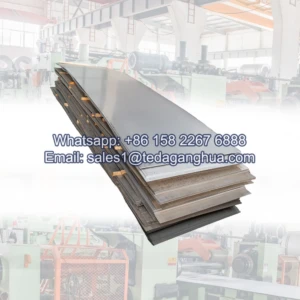
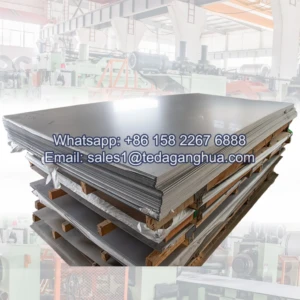
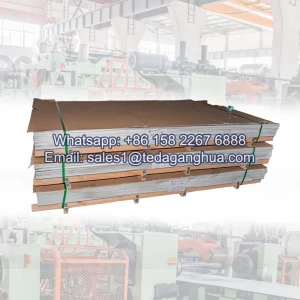
Como proveedor profesional de acero inoxidable, Teda Ganghua provides high-quality 316L stainless steel plates suitable for medical-grade fabrication and precision laser cutting applications. Our materials feature stable composition, excelente planitud, and reliable corrosion resistance for high-standard manufacturing requirements.
We support customized cutting, acabado superficial, and strict quality control for demanding industrial and medical applications.
Explore nuestros productos de acero inoxidable aquí:
Productos de placa de acero inoxidable
Conclusión
Laser cutting standards are critical in medical grade stainless steel fabrication, especially for 316L implant applications. Precisión, limpieza, and strict process control ensure safe, confiable, and high-performance implant manufacturing.